 AdvGamer
It’s been two years since Star Wars Outlaws landed in our hands, and I still vividly recall my first encounter with a certain locked container. There I was, Kay Vess crouched in a dim corner, Nix perched on her shoulder, and suddenly I was thrown into a mini-game that felt less like lockpicking and more like an impromptu percussion lesson. At the time, I thought I’d just failed miserably, but after talking with countless other players, I realized I wasn’t alone. That rhythmic lockpicking has become one of the most polarizing features in a galaxy far, far away. But in 2026, with cooler heads and plenty of hindsight, is it really as bad as we once thought?
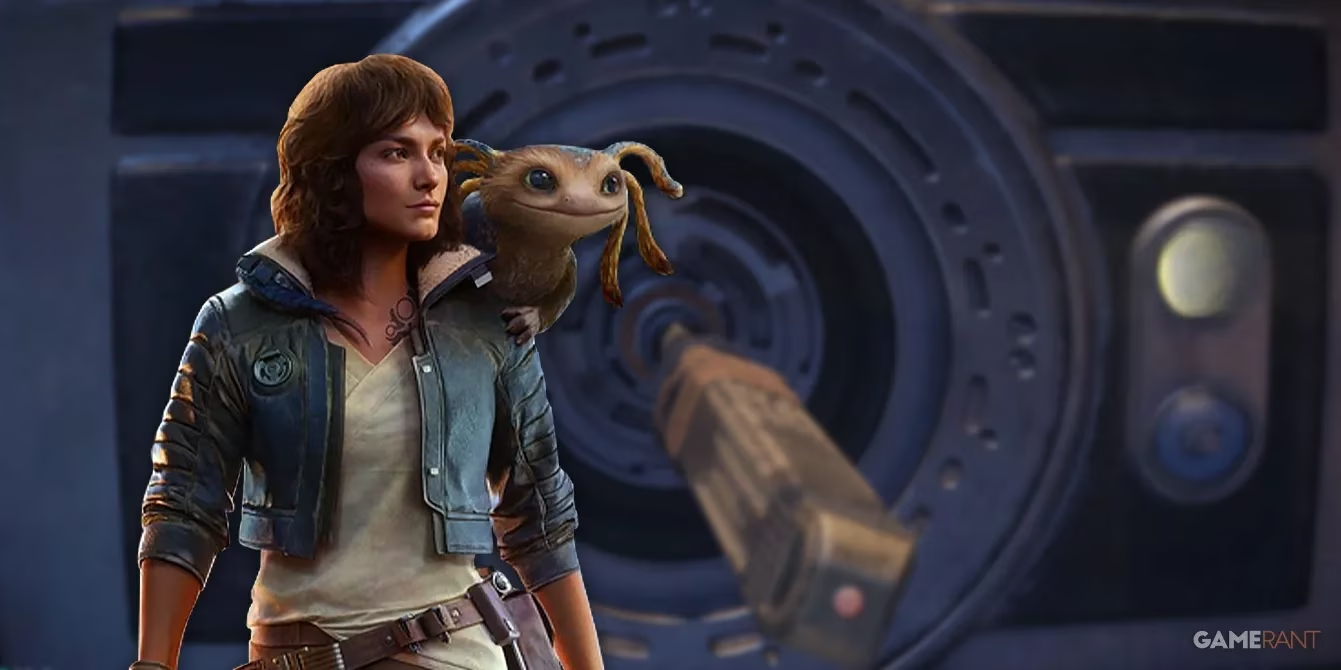
I’ll admit it: when I first struggled with the mini-game, I couldn’t believe a scoundrel’s life would hinge on my ability to tap out a beat. The core mechanic seems simple in description. A rhythmic pattern plays on repeat, and the player must echo it back exactly — start to finish, no shortcuts. But as anyone who’s sat through a dozen failed attempts knows, the execution is far trickier. The game demands a steady sense of rhythm. If you can’t internalise the pulse of those percussive clicks and pin bounces, you’ll be stuck outside that smuggling cache forever. Yet, isn’t that precisely what real lockpicking requires — a delicate feel for tension and a sensitivity to subtle feedback? Imagine a locksmith in our world. They don’t just see a lock; they listen to the clicks of pins and feel the resistance through the pick. So why should a Star Wars scoundrel be any different?
This leads me to a bigger question: have we been too hard on a mini-game that actually honours the franchise’s soul? Think about it. From the menacing brass of the Imperial March to the iconic snap-hiss of a lightsaber, Star Wars has always used sound to build its universe. Music and rhythm are practically part of the Force. When I replay missions today, I notice how often ambient sounds and John Williams–inspired motifs guide my actions — the rising tension before a Star Destroyer appears, the triumphant swell when I escape. Why shouldn’t a lockpicking challenge lean into that same auditory heritage? By making rhythm the central test, Massive Entertainment wove a small but meaningful thread into the larger tapestry of the saga.
Still, the frustration is real, and I’d be lying if I said the mini-game never made me want to launch my controller across the room. One of the biggest gripes is how easy it is to misunderstand where the pattern actually starts. When I first tried it, I’d jump in mid-loop, convinced I had the beat, only to be met with a glaring failure. The game expects you to identify the true beginning of the sequence, and starting from the middle won’t work. This is no memory-test like a Simon Says; it’s a pure rhythm audition. For players who struggle to hold a steady beat — whether due to a lack of musical training or just natural inclination — the lockpicking can feel exclusionary.
🤔 But here’s the twist: persistence often wins. I’ve since learned to let the pattern loop several times, tapping my foot along until the opening beat becomes unmistakable. With a little patience, that once-impossible puzzle turns into a satisfying mini-rhythm game. This raises the question: should a mainstream adventure game require that kind of patience and auditory skill? Many gamers have argued no, and the developers at Massive clearly listened. By launch, they had already included an option to bypass the mini-game entirely. In 2026, I look at that toggle as a masterstroke of player empathy. Whether they anticipated the division or simply wanted to accommodate all play styles, they ensured nobody would be permanently locked out of content.
The existence of that toggle doesn’t mean the mechanic is a failure, though. It simply means the team understood that innovation often comes with friction. And on a personal level, I’ve grown to appreciate the lockpicking precisely because it dares to be different. In a gaming landscape saturated with rotate-the-tumbler or pin-tumbler puzzles that feel interchangeable, Star Wars Outlaws tried something unusual. That’s worth acknowledging.
Let’s put things in perspective with a quick comparison of common lockpicking approaches:
| Game Type | Typical Mechanic | Primary Skill Tested |
|---|---|---|
| Traditional RPGs (e.g., Skyrim) | Rotate pick, find sweet spot | Visual precision & patience |
| Action-Adventure (e.g., Spider-Man) | Quick-time button matching | Reaction speed |
| Stealth (e.g., Splinter Cell) | Pin manipulation with audio cues | Patience & tactile feedback |
| Star Wars Outlaws | Rhythmic pattern repetition | Auditory rhythm & timing |
As you can see, Outlaws sits in a unique niche. It asks for a musical ear rather than a sharp eye, which is why it feels so alien to many of us who are used to visual minigames.
Two years on, what’s the lasting impact? Honestly, in the grand scheme of the game’s sprawling open worlds, speeder chases, and syndicate politics, the lockpicking is a tiny footnote. It rarely blocks critical path progression, and with the bypass toggle, it’s entirely optional. Yet, I find myself deliberately leaving the mini-game on now, treating each lock like a tiny performance. It has become one of those quirky idiosyncrasies that I remember fondly — much like a stubborn droid companion or a glitchy but lovable NPC. Can I recommend it to everyone? Absolutely not, and I’m grateful the bypass exists. But if you’re willing to lend it your ears and a little patience, you might discover that this controversial lockpicking system makes more sense than you initially thought, both in-universe and out.
So next time you boot up Star Wars Outlaws and crouch beside a locked chest, ask yourself: will you listen to the rhythm of the underworld, or will you flip the switch and move on? Either way, Kay’s adventure is waiting — and that’s what truly matters.