 AdvGamer
In the vast criminal underworld of the galaxy, Star Wars Outlaws transports players to the shadowy corners of familiar planets, offering a fresh perspective on locales once seen only in passing. While the game revisits iconic worlds like Tatooine and Kijimi, it reserves a particularly transformative spotlight for Cantonica, the casino planet from The Last Jedi. This time, however, the journey bypasses the glittering halls of Canto Bight entirely, plunging instead into the planet's neglected underbelly—the Slums. This shift in focus not only grounds the story of protagonist Kay Vess in a more relatable struggle but also recontextualizes the entire planet, painting it not as a monolithic playground for the rich but as a layered world with deep social fractures. The result is a version of Cantonica that feels more tangible and morally complex than its cinematic counterpart.
Audiences were first introduced to Cantonica through the desperate mission of Finn and Rose in The Last Jedi. Their objective was to find a Master Codebreaker within the opulent city of Canto Bight to disable a First Order tracker. The sequence was a whirlwind of spectacle: dazzling casinos teeming with wealthy war profiteers, a kaleidoscope of alien species engaged in high-stakes games, and an atmosphere dripping with excess—a vision so potent it earned the planet comparisons to a galactic Las Vegas. The film portrayed it as a gilded cage of hedonism, a place where the galaxy's elite indulged while conflict raged elsewhere. This portrayal, while memorable, was ultimately a surface-level glimpse, a postcard from a world of privilege.
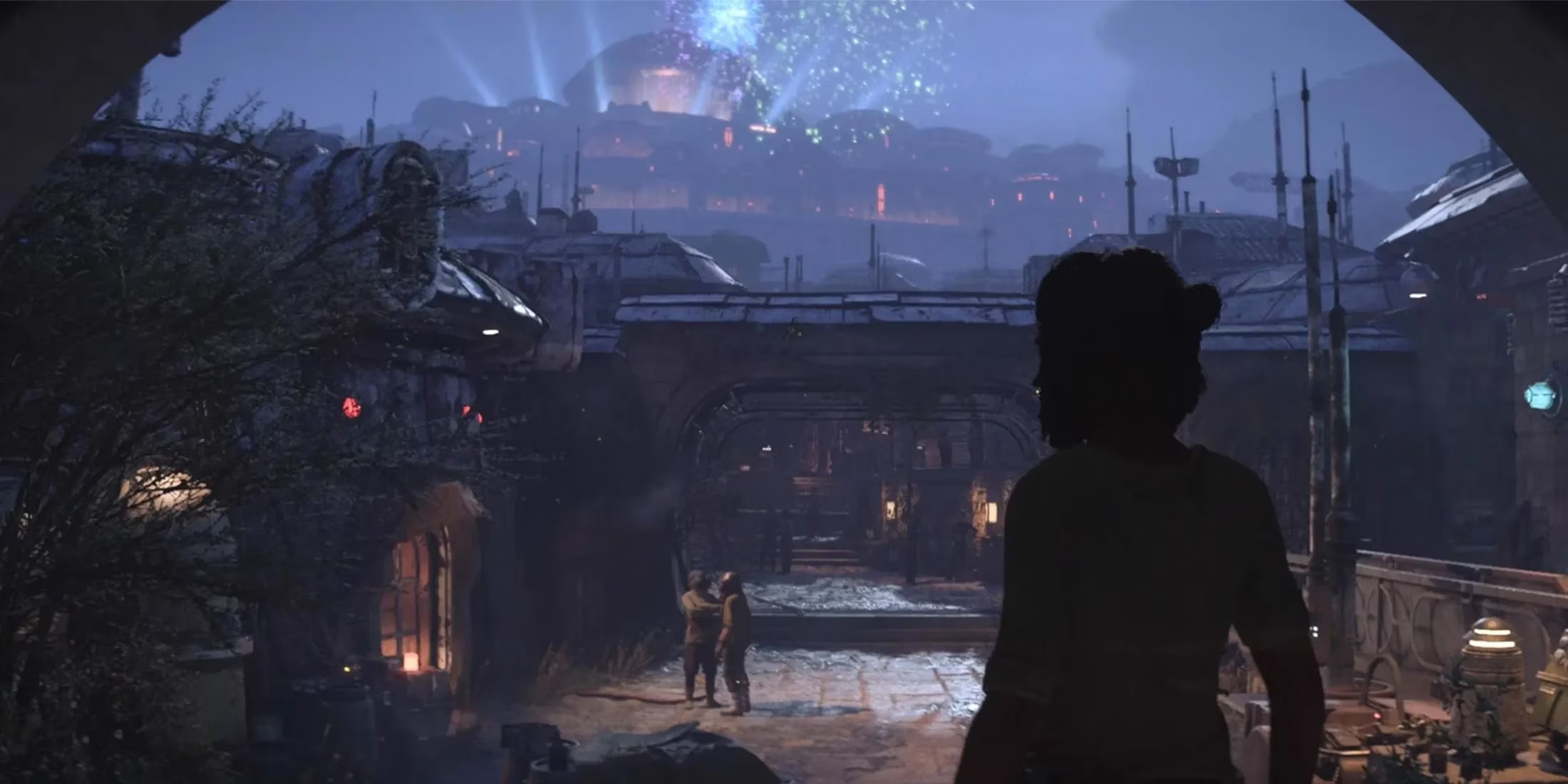
Star Wars Outlaws fundamentally subverts this initial impression. The game's opening acts as a deliberate counterpoint, immediately directing players away from the neon glow and into the fog-choked, rain-slicked alleys of the Slums. Here, the casino spires are distant, mocking silhouettes against a perpetually twilight sky. The environment is a character in itself:
-
Architecture: Buildings are worn-down and patched together, a stark contrast to the pristine, monolithic structures of Canto Bight.
-
Atmosphere: Thick fog and perpetual dampness replace dry, curated air. The dominant sounds are not the chime of slot machines but the drip of water and murmured conversations in shadowy corners.
-
Population: The residents are not tourists but survivors—locals scrambling to make ends meet through any means necessary, their lives a world apart from the revelry happening just over the horizon.
This new perspective is not merely aesthetic; it infuses the planet with narrative depth. Exploring the Slums feels like peeling back the gilded wallpaper of a mansion to reveal the rotting framework beneath. The district operates like a clandestine circulatory system, a network of hidden passages and illicit exchanges that keeps the glittering city above functioning, yet remains unseen and unacknowledged by its beneficiaries. Furthermore, the stark divide between the Slums and Canto Bight creates a societal tension that hums like a power cell on the verge of overload, a constant, unspoken conflict between the served and the forgotten.
The game enriches this environment through its inhabitants. Unlike the anonymous crowds of the casino, the NPCs in the Slums have stories etched into their weary expressions. Players can interact with a diverse cast, each representing a facet of life in the shadows:
| Character Type | Role in the Slums | Adds to World-Building By... |
|---|---|---|
| Frayed Informants | Selling secrets and rumors for scraps. | Showing how information is the primary currency in a lawless zone. |
| Jaded Mechanics | Keeping dilapidated speeders and tech running. | Demonstrating the resourcefulness and technical skill born of necessity. |
| Wary Merchants | Trading in salvaged parts and contraband. | Illustrating the informal, risky economy that exists outside galactic norms. |
| Ambivalent Enforcers | Imposing their own rough order, often for a price. | Highlighting the absence of formal authority and the rise of localized power structures. |
These interactions transform Cantonica from a backdrop into a living, breathing entity. It’s a place where every darkened doorway hints at a potential job, a new ally, or a dangerous foe. This approach gives the planet far more character and makes Kay Vess's journey through it feel consequential. Her story is no longer just about a heist in a shiny city; it's about navigating the complex, often brutal ecosystem that exists in the city's long shadow.
By 2026, the depiction of Cantonica in Star Wars Outlaws stands as a masterclass in expanding established lore. The game takes a location known for a single, specific tone—extravagant glamour—and reveals its essential duality. It posits that a casino planet isn't just about the games being played at the high-roller tables, but also about the desperate wagers being made in its basement levels. This exploration of contrasting sides—the glittering facade and the grimy foundation—strengthens the planet's place in the Star Wars canon, making it a richer and more compelling setting. The Slums of Cantonica, therefore, are not just a new area to explore; they are the vital, beating heart that the films never showed, proving that the most interesting stories are often found not in the light, but in the places it fails to reach.