 AdvGamer
In the sprawling neon-lit cantinas and shadowy spaceports of Star Wars Outlaws, amidst the hum of hyperdrives and the chatter of a thousand alien tongues, a player might find a moment of quiet, pixelated nostalgia. Tucked away like a forgotten holocron in a dusty corner, an arcade cabinet glows with a familiar, geometric light. This is not merely a diversion; it is a whisper from another era, a deliberate echo resonating across four decades of interactive galaxy-building. The game within the game, known as Raven 6, serves as a bridge—a shimmering, vector-drawn bridge—connecting the franchise's most ambitious open-world adventure to its humble, groundbreaking origins in a 1983 arcade cabinet.
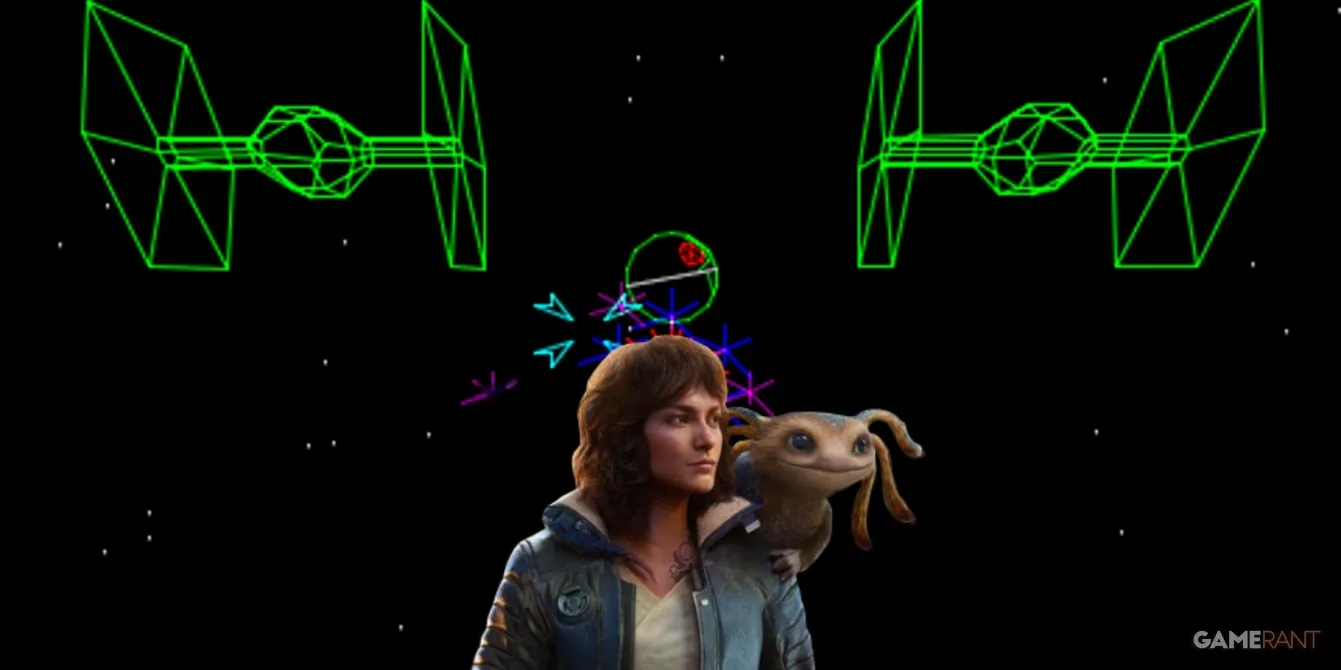
The journey of Star Wars in video games is a saga unto itself, beginning with a simple blip on an Atari 2600 screen in 1982. From that primordial spark, a universe of interactive stories erupted: tight movie adaptations, expansive original tales, and everything in between. Star Wars Outlaws, as the latest chapter, carries this legacy forward not just in its main narrative but in its hidden corners. Its minigames are often clever nods—a game of Kessel Sabacc tipping its hat to Solo, or Fathier racing echoing the beaches of Canto Bight. Yet, one minigame reaches back further, past the eras of the Skywalkers and the Solos, to the very dawn of Star Wars gaming itself.
That dawn was heralded by the iconic Atari Star Wars arcade cabinet in 1983. It wasn't just a game; it was an experience. Players climbed into the cockpit of Luke Skywalker's Red Five X-Wing, the world melting away into a first-person vector dream. The mission was pure, cinematic bliss:
-
Phase One: Battle swarming TIE Fighters in the blackness of space.
-
Phase Two: Skim the deadly surface of the Death Star, dodging turbolaser fire that streaked like angry comets.
-
Phase Three: The heart-pounding trench run, navigating a canyon of steel before the fateful shot into the exhaust port.
Its magic lay in its 3D color vector graphics. This was a universe rendered not in solid polygons, but in luminous, wireframe skeletons—TIE Fighters like angular dragonflies, the Death Star a skeletal moon, laser fire as crisp, glowing lines. This technology, rudimentary by today's standards, possessed a timeless charm. Its simplicity was its strength, creating a stark, vibrant world that felt both futuristic and strangely intimate, like a blueprint of the imagination itself.
🎮 Fun Fact: The vector display meant images were drawn line-by-line by an electron beam, resulting in incredibly sharp, bright graphics that seemed to float in the dark cabinet. It was less a screen and more a window into a world of pure light.
Enter the Raven 6 minigame in Star Wars Outlaws. When a player approaches this particular arcade machine, they are not simply starting a game; they are stepping through a temporal rift. The connection is immediate and profound:
| Feature | Atari's Star Wars (1983) | Outlaws' Raven 6 (2026) |
|---|---|---|
| Perspective | First-person cockpit view | First-person cockpit view |
| Core Gameplay | Fly through space, blast enemies & avoid hazards | Fly through space, blast enemies & avoid hazards |
| Visual Style | 3D Color Vector Graphics (wireframe) | 3D Vector-Style Graphics (geometric framework) |
| Aesthetic | Colorful, glowing outlines on black | Colorful, geometric shapes on cosmic backdrop |
The gameplay parallel is clear, but it is the visual homage that truly sings. Raven 6 does not render its ships and asteroids as the detailed, textured models found elsewhere in Outlaws. Instead, they emerge from the void as angular constellations of light, frameworks of pure geometry that glide and spin with a nostalgic elegance. Enemy crafts approach not as solid threats, but as translucent schematics made of neon, like architectural ghosts from a digital past. As the minigame progresses, splashes of color—vivid blues, urgent reds, warning yellows—wash over these forms, mirroring the iconic palette of the Atari classic. This isn't mere retro styling; it is a loving re-creation, a conscious decision to house 2026's technology in 1983's aesthetic skin.
This reference is a poetic full circle. The 1983 game was a pioneering attempt to make players feel the Star Wars universe, using the most advanced tech of its day. Star Wars Outlaws, nearly 45 years later, achieves a similar goal on an unimaginably grander scale. By embedding Raven 6 within its world, the developers acknowledge their roots. They remind us that this vast, living galaxy we now explore began as a series of glowing lines on a dark screen. The Raven 6 cabinet is more than an Easter egg; it is a monolith of memory, a tribute to the pioneers who first translated the roar of a TIE fighter and the thrill of the trench run into joystick commands and vector beams. In the bustling, modern canon of Star Wars games, it stands as a quiet, beautiful testament to where the journey began—a journey that continues, forever, in a galaxy far, far away.