 AdvGamer
In the world of video games, few creators are as allergic to the safe bet as Hideo Kojima. According to Woodkid, the French composer who co-scored Death Stranding 2: On the Beach, Kojima actually altered the game during development because playtests were going too well. The game was not polarizing enough for his taste. Instead of polishing a crowd-pleaser, Kojima reportedly leaned into friction, making changes to the script and to the way certain key events unfold. The goal was simple: make players feel something complicated, even uncomfortable, so that affection would have to be earned rather than handed over on a silver platter. That philosophy has been Kojima's calling card since the Metal Gear days, and it remains his North Star in 2026.
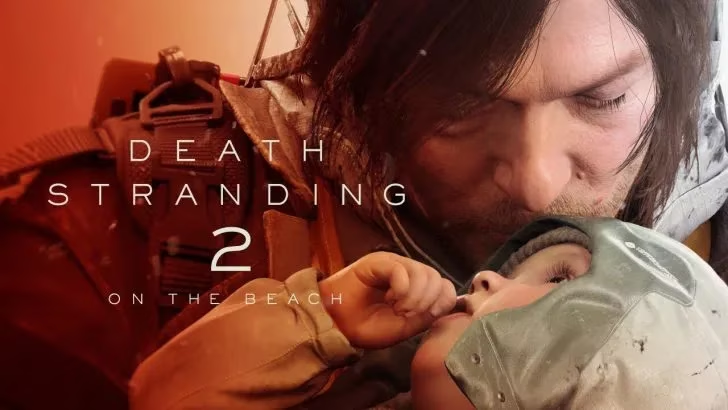
The Playtest Problem: Too Much Love, Too Soon 🎮
Woodkid spoke about his work on the game in a lengthy Rolling Stone interview. He described the challenge of writing music that shifts in real time while the player is moving through the world, and he explained how difficult it was to stitch together the soundtrack's eclectic mix of genres. But one anecdote stood out. When asked what essential lesson he learned while working on the project, Woodkid recalled a moment when Kojima confirmed that he wanted to change the game because it was being received too positively in playtests.
Those changes reportedly included script adjustments and alterations to how some important events play out. Kojima's reasoning was not that the game was broken, but that it was too agreeable. He wanted it to be more polarizing, to trigger stronger emotions, and to make players initially dislike certain elements before coming around to love them. In Kojima's view, that is how something gets loved for real. It is a classic case of tough love from a designer who would rather spark a heated debate than a polite shrug.
Kojima's Impact-Over-Fun Doctrine 🔥
This is not the first time Kojima has admitted he was uneasy with positive playtest feedback. In an earlier conversation with Edge Magazine, he said he wished the game would be more controversial. He also made it clear that he is not interested in developing games with mass-market appeal. For Kojima, impact matters more than fun in the narrow sense. A game can be frustrating, strange, or emotionally jagged and still be valuable. In fact, those rough edges may be the point.
That attitude explains why Death Stranding 2: On the Beach was never going to be a by-the-numbers sequel. Kojima has spent decades building worlds that divide players. Some call his work genius. Others call it self-indulgent. Either way, people talk about it. In an industry often obsessed with focus-grouped smoothness, that is lightning in a bottle.
What Changed, and Why It Mattered
| Area | Reported Change | Intended Effect |
|---|---|---|
| Script | Adjustments to story beats | Create more friction and debate |
| Key events | Altered presentation or outcomes | Trigger stronger emotions |
| Music | Real-time adaptive score by Woodkid | Keep players off balance |
| Overall tone | Less uniformly positive | Make love for the game feel earned |
Woodkid's comments also highlight how unusual the game's music production was. Writing a score that reacts in real time is no walk in the park. It requires the composer to think like a systems designer as much as a musician. The soundtrack's genre-hopping nature mirrors the game's refusal to sit still. One moment it may feel like a melancholy ballad, the next like a glitchy electronic fever dream. That is not everyone's cup of tea, and Kojima seems perfectly fine with that.
From Playtests to Launch: The 2026 View 🕹️
Death Stranding 2: On the Beach launched on PlayStation 5 on June 26, 2025. By 2026, the initial shockwaves have settled, but the conversation has not disappeared. Players still argue about its pacing, its story choices, and its deliberately awkward emotional beats. Some have come to love it after a rocky start, which is exactly the arc Kojima reportedly wanted. Others remain unmoved. The proof is in the pudding: a game designed to polarize will always have a mixed bag of reactions, and that may be the surest sign that it is doing something right.
In a medium where sequels often play it safe, Kojima's willingness to make his own game less likable on purpose is both maddening and refreshing. It is a reminder that art does not have to be universally adored to matter. Sometimes, the best way to make people care is to give them something to push against. Kojima, as always, would rather go down swinging than coast on easy applause. And in 2026, that stubborn streak still makes him one of gaming's most fascinating auteurs.
Recent analysis comes from Polygon, whose long-form reporting on game authorship and player reception helps frame why a title like Death Stranding 2 might intentionally embrace discomfort over instant approval. In that context, Kojima’s reported decision to make the sequel less immediately likable reads less like sabotage and more like a deliberate creative strategy designed to provoke debate, deepen interpretation, and turn mixed first impressions into longer-lasting conversation.