 AdvGamer
Looking back from 2026, I can still vividly recall the industry-wide surprise when Ubisoft announced that Assassin's Creed Shadows would miss its targeted November 2024 release window. That decision, arriving just weeks before the originally planned launch, felt like a seismic shift for a publisher that had long treated the holiday quarter as sacred ground for its flagship franchise. Now, more than a year after Shadows finally arrived on February 14, 2025, the ripples of that strategic pivot continue to define not only the game itself but also Ubisoft’s entire approach to development and community relations.
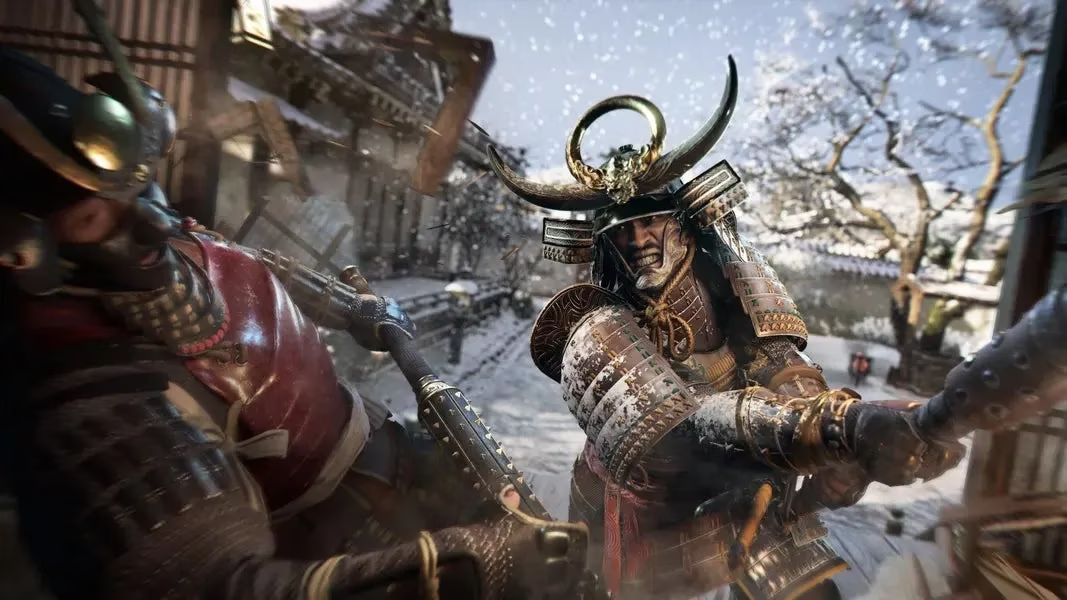
The road to that Valentine’s Day launch was anything but smooth. In late September 2024, Ubisoft confirmed that all pre-orders for the original November date would be refunded, a costly move that signaled just how seriously the company was taking the situation. The official explanation was that the game was "feature complete" — exactly what you would hope for a title so close to its intended debut — but that it required additional polish. What made the delay truly fascinating, however, was the blunt admission that it was directly triggered by the disappointing commercial performance of Star Wars Outlaws, which had launched the previous August to what Ubisoft described as a "solid" critical reception but lukewarm sales. For the first time, the publisher was openly using one blockbuster’s stumble as a teachable moment for another.
As a player who has followed this series for years, I remember feeling a mix of frustration and cautious optimism. Frustration because waiting an extra few months for the first Assassin’s Creed set in feudal Japan — a dream setting fans had begged for — was agonizing. But optimism because Ubisoft promised that the extra time would let them fully deliver on the dual protagonist adventure, with Naoe’s stealth-focused agility and Yasuke’s samurai combat offering two distinct gameplay styles. The company made it clear that they were prioritizing a player-centric, gameplay-first philosophy, a phrase that has since become a cornerstone of their public messaging right through to 2026.
One of the most consequential changes that came alongside the delay was the decision to launch Shadows on Steam simultaneously with other platforms on day one. Previously, Ubisoft had often kept its PC releases exclusive to its own store and the Epic Games Store for varying periods. The shift to an immediate Steam release not only acknowledged the platform’s massive user base but also set a precedent that has now become standard for all major Ubisoft titles. By 2026, no one bats an eye when a new Far Cry or Assassin’s Creed appears on Steam at launch, but back then it felt revolutionary — a direct response to fan demands and a lesson learned from the "softer than expected" performance of titles that had arrived on Steam late.
Equally noteworthy was the scrapping of the series’ familiar season pass model. Instead of selling a premium pass guaranteeing future expansions, Ubisoft announced that the first major DLC for Shadows would be granted free to anyone who pre-ordered. This move, which felt like an olive branch to a community that had grown weary of fragmented content delivery, has since influenced how post-launch support is structured across the publisher’s portfolio. Even in 2026, we see echoes of that decision as studios increasingly favor expansive free updates over rigid paid roadmaps.
Beyond business models and platform strategies, the delay also became entangled with a broader cultural conversation. Company boss Yves Guillemot used the announcement moment to address what he called "polarised comments" around Ubisoft, insisting that the firm is an entertainment-first company with no intention of pushing any specific agenda. This was widely interpreted as a reaction to the controversy whipped up online regarding the inclusion of the African historical figure Yasuke as a samurai protagonist. When Ubisoft later clarified that the goal is simply to give teams creative freedom while staying focused on player experience, it did little to quell the debate. As I write this in 2026, those discussions have evolved but haven't disappeared; the game itself ultimately earned praise for its nuanced portrayal of both Naoe and Yasuke, yet the pre-release noise stands as a stark reminder of how quickly player passion can turn volatile.
Reflecting on the past year, I can say that the extra polish time did make a difference. The day-one experience of Assassin’s Creed Shadows felt far more stable and cohesive than what early footage had suggested, and the dual-protagonist system delivered genuine variety. The free expansion, when it arrived, helped sustain momentum during a typically quiet summer period. And the Steam launch generated the kind of concurrent player numbers that had eluded Star Wars Outlaws for months. None of this erases the lost holiday 2024 sales or the anxiety that delay caused among investors, but from a player’s standpoint, the February 2025 release transformed a potential disappointment into one of the series' standout entries.
Perhaps the biggest legacy of that delay is the way it reshaped Ubisoft’s internal culture. In 2026, Guillemot’s promised review of project execution has become visible in every new reveal. The company now emphasizes iterative feedback loops with content creators and fans well before release dates are set in stone. The phrase "completely feature complete" is no longer seen as a shield against criticism; instead, it’s understood that a game needs to be fun and polished, not just technically whole. Learning from Star Wars Outlaws proved to be the harsh catalyst that forced a proud publisher to hit pause on its crown jewel, and the industry is better for it. As a gamer who lived through that uncertain autumn of 2024, I’m grateful that Ubisoft chose to listen — even if it meant enduring an extra-long wait for a journey through feudal Japan.