 AdvGamer
Back when Death Stranding 2: On the Beach was still a trail of cryptic State of Play footage, the big question was whether its dust-choked vistas and impossible cargo routes were running on real hardware or a carefully staged dream. Hideo Kojima eventually answered that in a Hideotube video: the trailer had been captured on PlayStation 5. In 2026, with the game no longer a future promise, that detail reads less like marketing reassurance and more like a starting line. Kojima also argued that the graphics would improve even further—a bold claim at the time, like promising to polish a glacier while it is still calving into the sea.
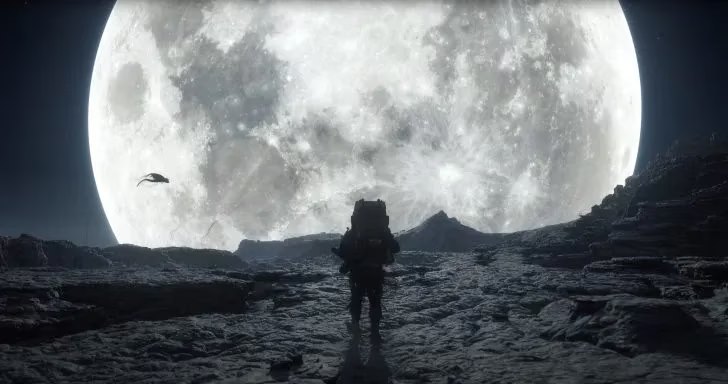
According to Kojima, the most consequential upgrade is not raw resolution but real-time terrain deformation. The world can change under the player's feet and, more importantly, under the player's plans. Earthquakes can cut off roads, forest fires can reshape routes, and floods can erase the safe path someone mapped minutes earlier. In practice, that turns navigation into something closer to reading a map drawn in wet cement: the information is useful, but the surface keeps moving. It also gives the sequel a different kind of tension from the first game. Death Stranding was often about preparing for a hostile landscape; this follow-up sounds like it wants players to react when the landscape refuses to stay prepared.
Kojima also offered a production snapshot. The assets were ready and needed to be constructed; Japanese dubbing was set to begin that year ahead of the following year's release. That timetable made sense in the original pre-release window, and by 2026 it serves as a marker of how far the project has traveled. The conversation has shifted from speculation about capture hardware to analysis of the finished game. The original plan pointed to a launch in the following year on PlayStation 5; in 2026, that window is historical context rather than breaking news.
Story details were another major part of the discussion. The sequel takes place on a continent outside America, which immediately changes the series' cultural and geographical texture. Kojima touched on a puppet modeled after German director Faith Akin, Elle Fanning's character, the Drawbridge group, Fragile's role, and how development has evolved since the first game. These are not random bullet points; they are the kind of threads Kojima pulls with the enthusiasm of a theater director explaining why the scenery needs to move during the monologue.
| Topic | What Kojima said | Why it matters |
|---|---|---|
| Visual capture | The trailer was captured on PS5 | It grounded the footage in real console hardware rather than a PC-only showcase |
| Graphics | They would improve further | It set expectations for the final release beyond the State of Play demo |
| Terrain | Real-time deformation affects gameplay | Roads can be cut off by earthquakes, fires, and floods |
| Production | Assets ready; Japanese dubbing planned | It gave a clear snapshot of the project's pipeline |
| Story | Set outside America; Drawbridge and Fragile return | It expands the series' world and cast beyond the first game's focus |
| PHYSINT | Movie-like, but still a video game | It shows Kojima's continued interest in blending cinematic and interactive forms |
Kojima also briefly discussed PHYSINT, likening it to a movie while confirming that it will still be a video game. That phrasing is classic Kojima: a promise that the boundary between cinematic presentation and interactive systems will be treated as a membrane rather than a wall. For players, the more immediate takeaway remains Death Stranding 2 itself. The game's pitch is not simply prettier scenery or stranger cargo. It is a world that can sabotage the route while the player is walking it.
By 2026, Death Stranding 2: On the Beach is best understood as a PS5 showcase that aged into a test case for Kojima Productions' ambitions. The trailer's visual quality was impressive when it was first shown, and Kojima's claim that the graphics would improve further now reads as confidence rather than hype. The real-time terrain deformation gives the sequel a mechanical identity, while the move beyond America gives it a narrative one. The result is a game that asks players to treat the environment not as a backdrop but as a restless collaborator—one that can help, hinder, or simply change the map while the delivery is still in progress.